Muki's Workshop
A classroom workshop game where students learn multiplication by counting objects in train wagons — seeing how the number of carts and windows per cart build into multiplication.

Overview
Muki’s Workshop is an interactive classroom game developed as part of a year-long mathematics curriculum for Israeli elementary schools, approved by Israel’s Department of Education. Students are invited into a warm wooden workshop classroom where character Orit — wearing her overalls and accompanied by Muki on her shoulder — leads them through a hands-on exploration of train patterns and multiplication.
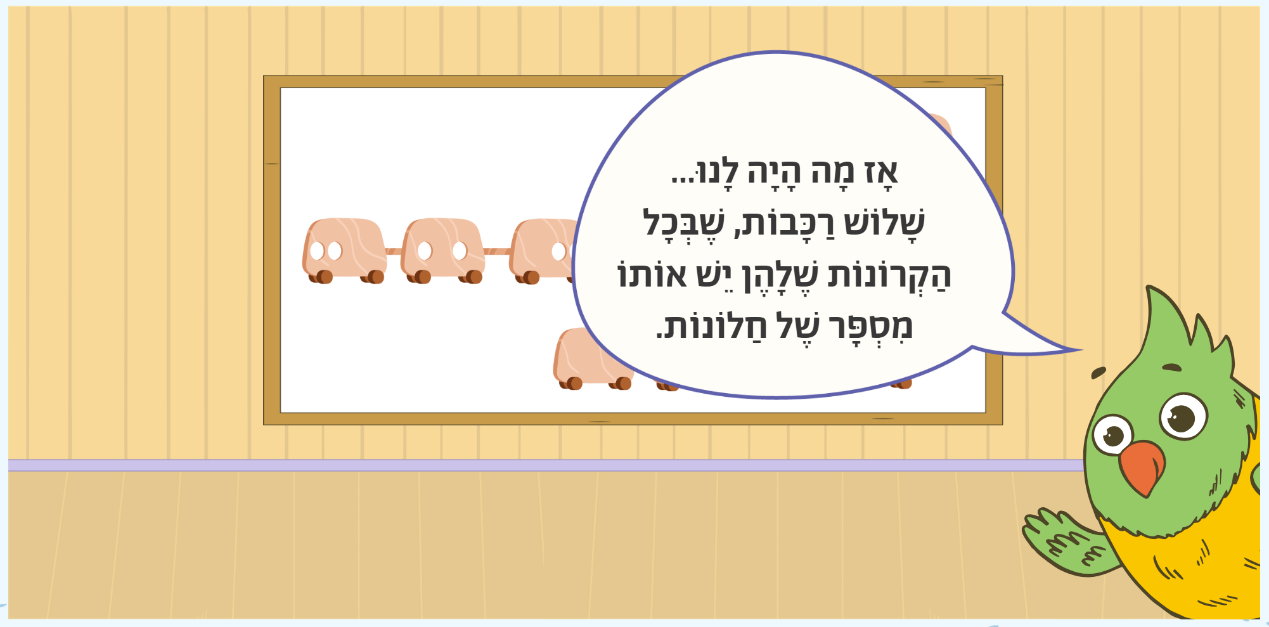
The central concept is deceptively simple: trains roll across a whiteboard, and students must analyze their wagons. How many wagons? How many windows per wagon? What pattern holds between them? Through repeated engagement with these questions, children build an intuitive grasp of multiplication as repeated grouping — without ever feeling like they’re doing drills. The workshop setting makes math feel like a craft: something built with care, examined closely, and shared with classmates.
My Role
I was responsible for the full design lifecycle — from narrative concept through final screen delivery — working alongside the pedagogy team and illustrator Aviel Basil.
Screen design & UX flow. I designed every screen in the game: the welcome sequence, the whiteboard challenge states, the answer-card interactions, feedback moments, and question progression. The interface had to be readable by students who are still building literacy, so visual clarity was paramount — large answer cards, clear spatial composition on the whiteboard, and a question counter that keeps students oriented throughout the session.
Creative concept & workshop narrative. The “workshop” frame was a deliberate creative choice. Rather than placing students in front of a generic quiz, I developed a narrative in which they arrive at Orit’s classroom workshop as participants — an environment associated with making, building, and figuring things out together. That shift in framing changes how students relate to the challenges.
Art direction. I worked closely with illustrator Aviel Basil, directing the character poses, the classroom environment, and the wooden workshop aesthetic: the clock on the wall, tools hung neatly in the background, warm lighting, and the physical sense of a space built for learning. Each asset was reviewed and refined to ensure it felt consistent with the established visual language of the curriculum series.
Pedagogy collaboration. I worked hand-in-hand with the pedagogy team throughout the project — aligning the interaction design to the mathematical concepts being taught. The thumbs-up/thumbs-down mechanic was specifically designed to support the true/false reasoning patterns used in the classroom, encouraging students to commit to a judgment before seeing the outcome.

Interaction Design
The core mechanic centers on the whiteboard. Muki the parrot presents a statement about a train pattern — “these three trains all have the same number of windows” — and students must decide: true or false. Each student holds up an answer card, and the room commits together before the answer is revealed.
This group-response mechanic does two things: it keeps every student in the classroom actively engaged rather than passively watching, and it creates a social dimension around mathematical reasoning. Being wrong alongside your classmates feels different from being wrong alone — it opens space for discussion rather than shame.
Key Screens
The game moves through a sequence of question sets, each with a counter that shows students where they are in the session (1/6, 1/3 depending on the activity set). A celebratory feedback moment closes each round, reinforcing the sense of achievement and keeping the pacing energetic.
